
This is an independent brand-strategy proposal for UBS, based on the public materials cited below. “UBS Augmented Advice”, its creative concepts, standards, journey designs and measures are proposals; they are not official UBS communications, an implemented client engagement or reported results. UBS has not endorsed the proposal.
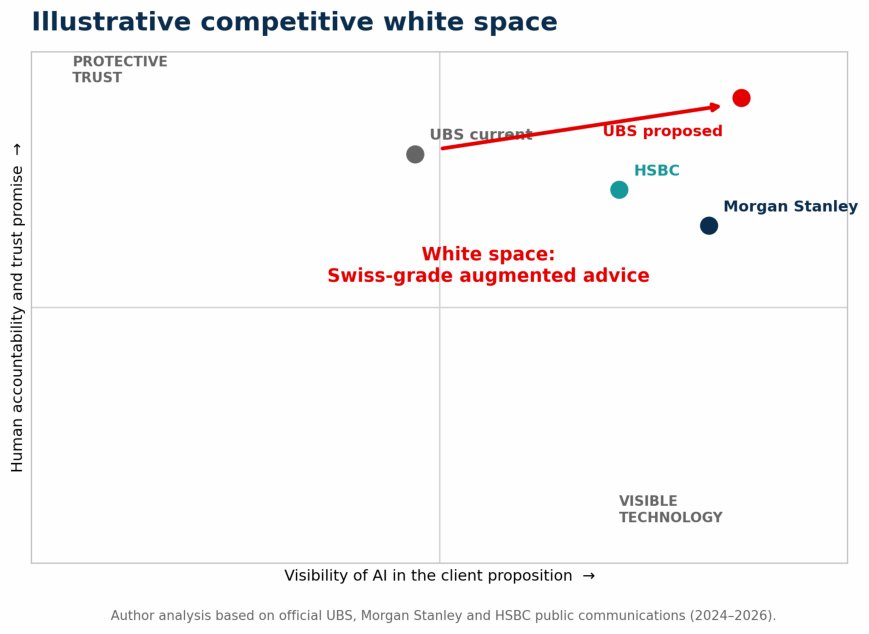
UBS can own the premium white space between invisible automation and AI-led advice: technology broadens the field of vision; an accountable adviser turns it into judgement. This would make the benefit of technology easier for clients to understand.
The strategic opportunity
As wealth managers compete to own the most distinctive brand position, the race increasingly centers around delivering the most advanced capabilities without compromising trust. UBS can differentiate by branding its existing AI capabilities as an extension of its trusted, personalised advisory model, transforming cutting-edge technology into a luxury brand asset.
Brand introduction
UBS is a global financial-services brand headquartered in Zurich, operating across wealth management, personal and corporate banking, asset management and investment banking. Its strategic centre of gravity is Global Wealth Management, where the firm presents itself as the world’s only truly global wealth manager. At the end of 2025, UBS reported USD 7.005 trillion in total invested assets, of which USD 4.753 trillion was within Global Wealth Management, supported by 9,420 advisers (UBS Group AG, 2026). Brand Finance valued UBS at USD 14.1 billion in 2025, equal to 70% of the combined value of Swiss banking brands in its ranking (Brand Finance, 2025).
The proposed audience includes wealthy individuals, entrepreneurs, executives and families whose financial lives cross jurisdictions, generations and asset classes. Their criteria extend beyond investment performance. The cited EY research connects provider choice with reputation, adviser relationships and digital tools, while also showing potential movement of assets between providers (EY, 2025). For UBS, the question is how to make relevance as memorable as reputation.
UBS launched Branding campaign “Banking is our craft” in 2024 to unite the enlarged group after the Credit Suisse acquisition and strengthen awareness, familiarity and reputation across twelve markets (UBS, 2024). “Craft” carries useful associations of precision, dedication, heritage and tailored work. UBS can now build on this by making its responsible AI capability visible and meaningful as a client benefit, while retaining the judgement, discretion and personal accountability that embody premium advice. UBS is one of several market leaders; within the emerging category of visibly branded, AI-enabled advice, it has room to behave like a challenger.
Brand audit
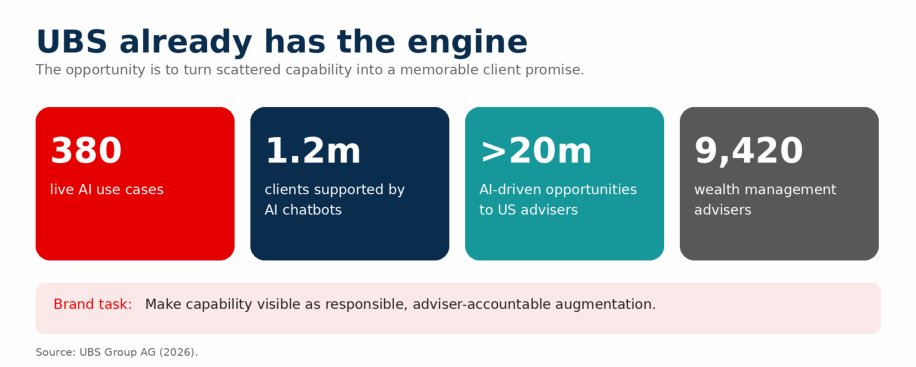
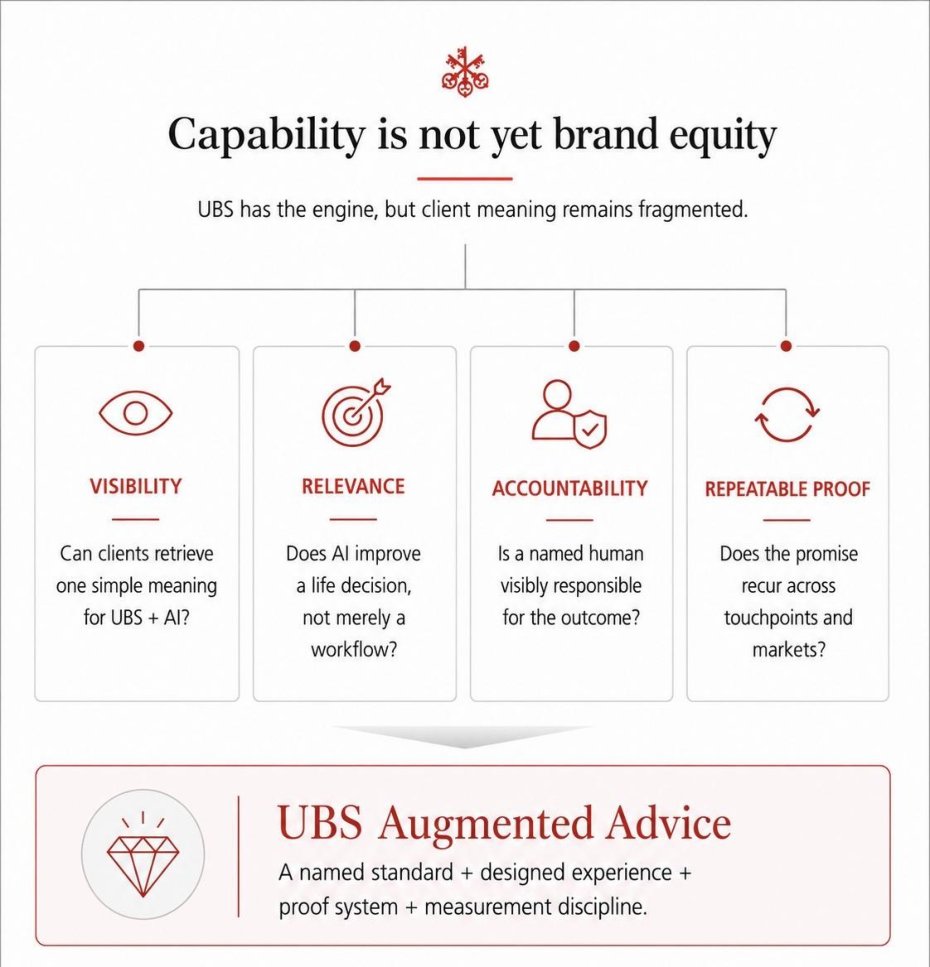
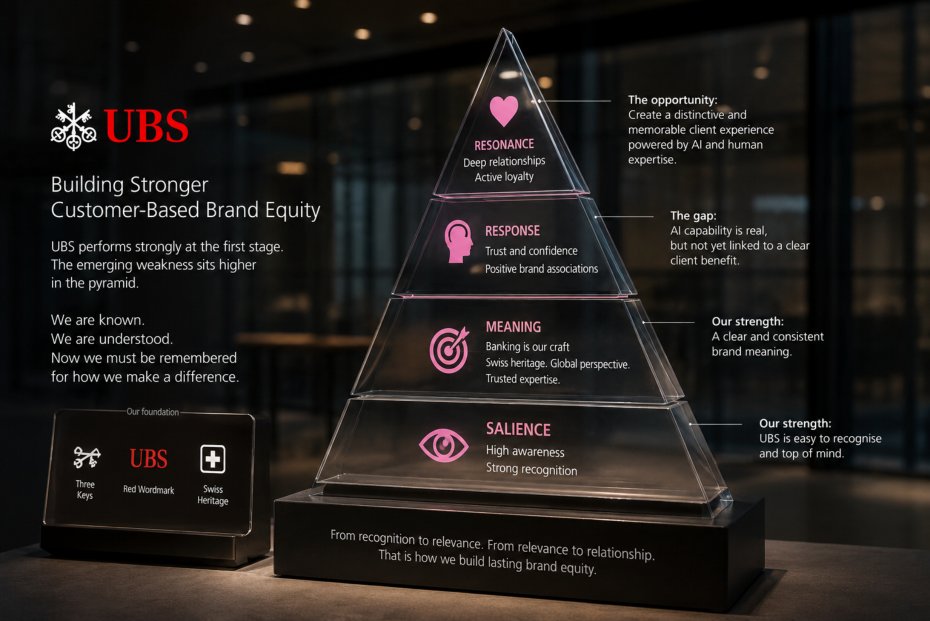
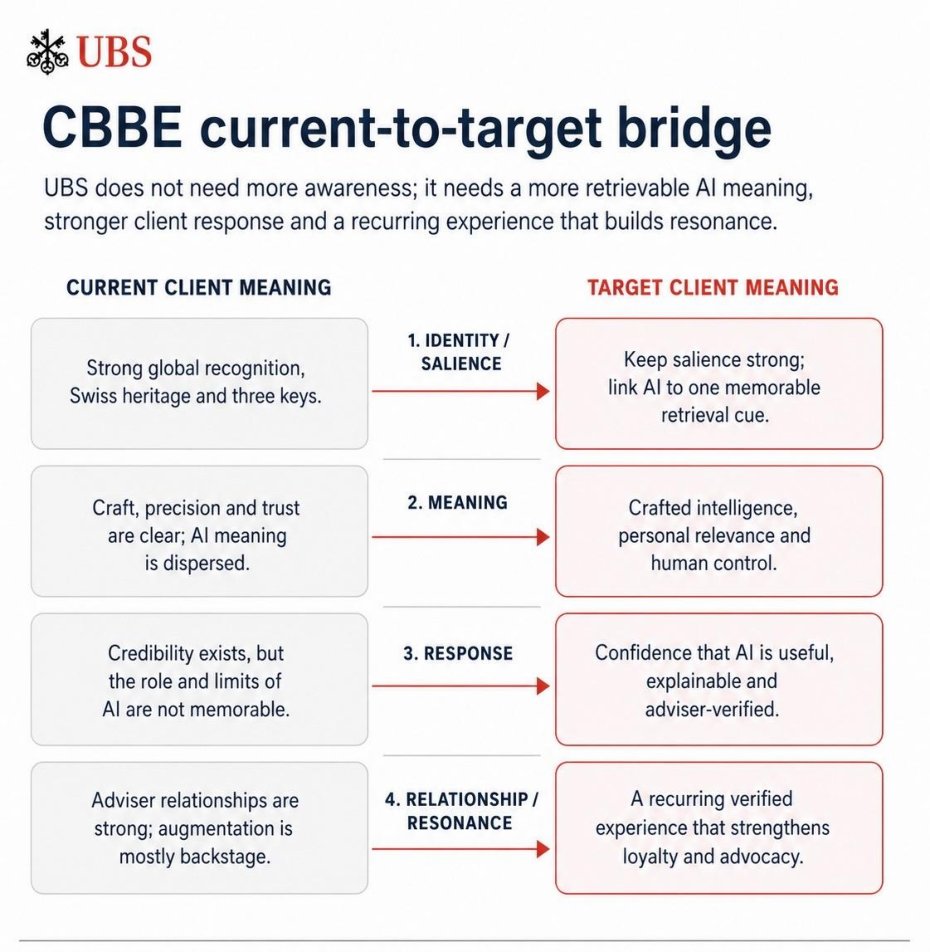
UBS has built extensive AI capability. Its next brand advantage comes from making that capability easy to understand and visibly accountable to a human adviser and client.
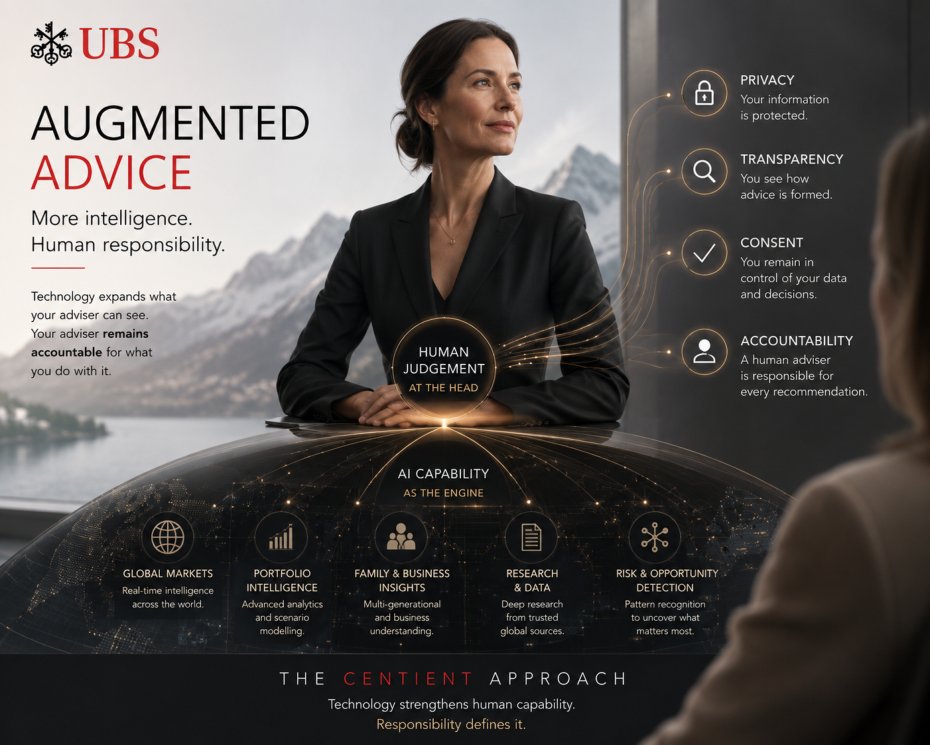
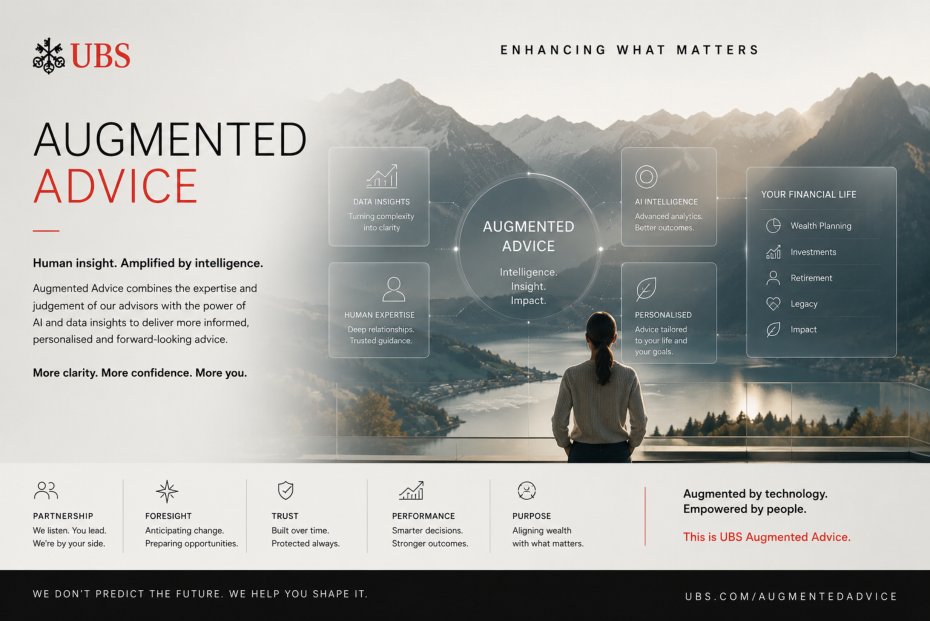
UBS has a substantial base of AI capability, adviser relationships and governance. My proposal is to make that capability easier for clients to understand through UBS Augmented Advice: “Technology finds more. You and your adviser decide what matters.” The idea extends “Banking is our craft” into the advice journey while keeping human accountability visible.
The market tension
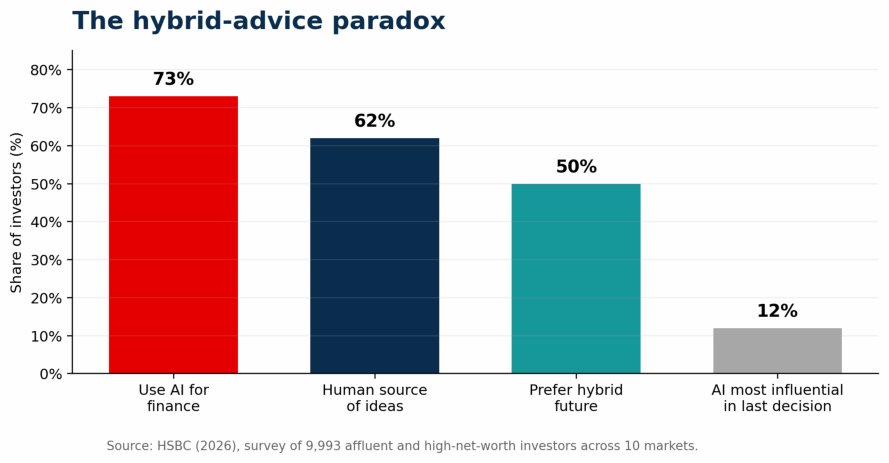
Wealth management faces an awkwardly productive tension: people can use AI while still wanting a person involved in consequential decisions. HSBC’s cited 2026 survey of almost 10,000 affluent and wealthy investors reported 73% using AI for finance and investment, 12% naming AI as the most influential factor in their latest investment decision, and half preferring a hybrid future. These measures describe different questions; they should not be read as mutually exclusive groups (HSBC, 2026).
The cited Capgemini research points to a personalisation gap: it reports that only 17% of wealthy clients regard their advisory experience as seamless and personalised, while firms commonly segment by wealth band (Capgemini Research Institute, 2026). A wealth band cannot describe every need involving a business, inheritance, philanthropy or cross-border life. That suggests an opportunity to improve the adviser’s preparation and responsiveness.
UBS’s cited 2025 annual report describes 380 live AI use cases, AI-powered chatbots serving 1.2 million clients and more than 20 million AI-driven client opportunities distributed to US advisers (UBS Group AG, 2026). Its public AI materials also describe the Oxford-UBS Centre for Applied AI and principles covering human autonomy, harm prevention, fairness and transparency (UBS, 2026). The brand question is what a client understands from that capability. Concerns about privacy, opaque decisions and loss of control can shape responses to AI (Puntoni et al., 2021). Making responsibility visible is therefore part of the proposition, not a footnote (Shneiderman, 2020).
Identity, image and the relevance opportunity
Keller’s customer-based brand-equity model offers a way to distinguish recognition from meaning (Keller, 1993). UBS has familiar assets: the three keys, red wordmark, Swiss heritage and global footprint. My diagnosis is that its AI story is more dispersed across annual reporting, technology pages and tools. A memorable organising idea could help clients connect those pieces. This is a strategic interpretation of public communications, not a consumer-awareness survey.
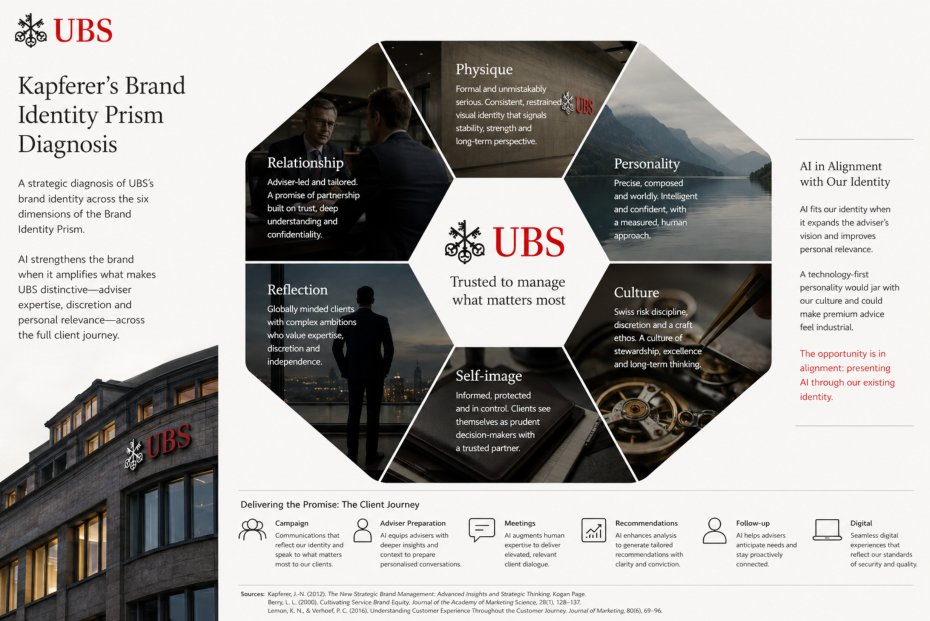
Kapferer’s Brand Identity Prism offers another useful check (Kapferer, 2012). I interpret UBS’s personality as precise and composed, its culture as drawing on discretion and a craft ethos, and its relationship promise as adviser-led and tailored. AI fits that identity when it extends the adviser’s view and makes the experience more relevant. If it makes advice feel impersonal, the technology story could work against the premium promise.
| Identity dimension | Author’s interpretation |
|---|---|
| PHYSIQUE | Three keys, red wordmark, premium global platforms |
| PERSONALITY | Precise, composed, worldly |
| CULTURE | Swiss discipline, craft, responsibility |
| RELATIONSHIP | Adviser-led, tailored, accountable |
| REFLECTION | Globally minded client with complex ambitions |
| SELF-IMAGE | Informed, protected and in control |
For service brands, the company itself is the brand, and every interaction with the customer shapes brand equity (Berry, 2000). Similarly, Lemon and Verhoef (2016) argue that value is created across the entire customer journey. Therefore, UBS’s AI positioning must be consistently reflected in marketing, adviser preparation, client meetings, recommendations, follow-up and digital services. Otherwise, it risks becoming a short-lived campaign rather than a meaningful and defensible brand differentiator.
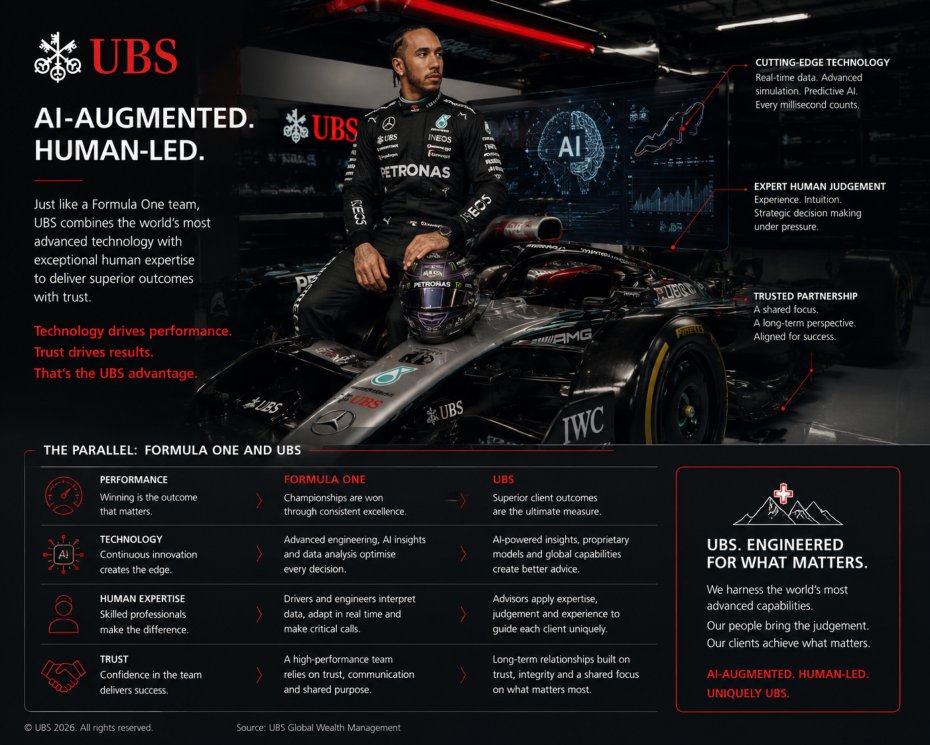
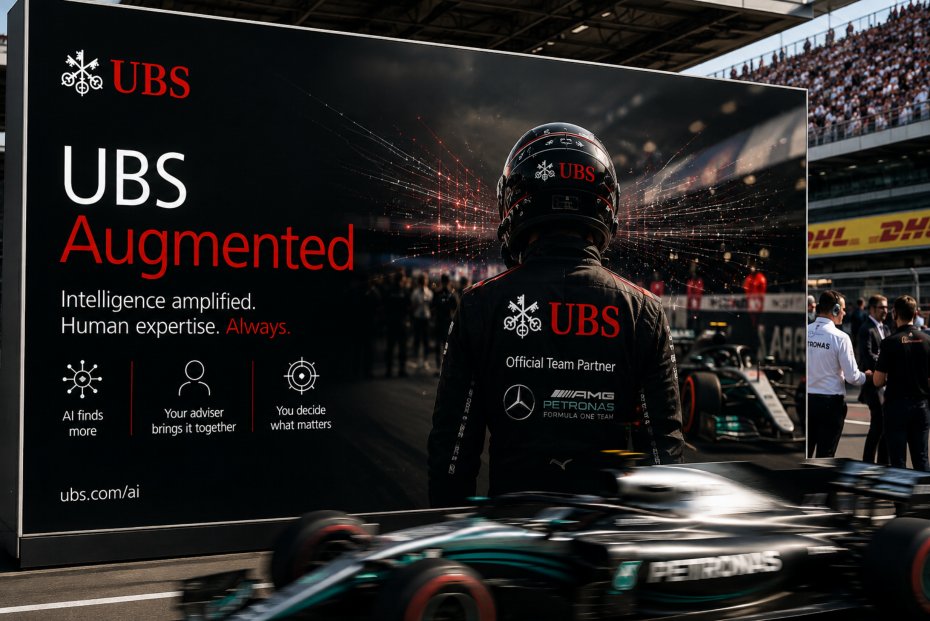
Formula One gives me an analogy for the idea. Engineering expands capability; drivers, engineers and the team interpret what to do with it. That is a useful way to explain augmented advice without pretending that a financial decision is a race or that better technology guarantees better investment performance.
There can be a sense of luxury in having sophisticated tools in the hands of people who know how to use them. The informational-efficiency debate helps explain why access to information and the cost of interpreting it matter (Grossman and Stiglitz, 1980). For this proposal, the promise should be broader research, stronger preparation and a clearer conversation—not privileged foresight or assured returns.
Competitive white space
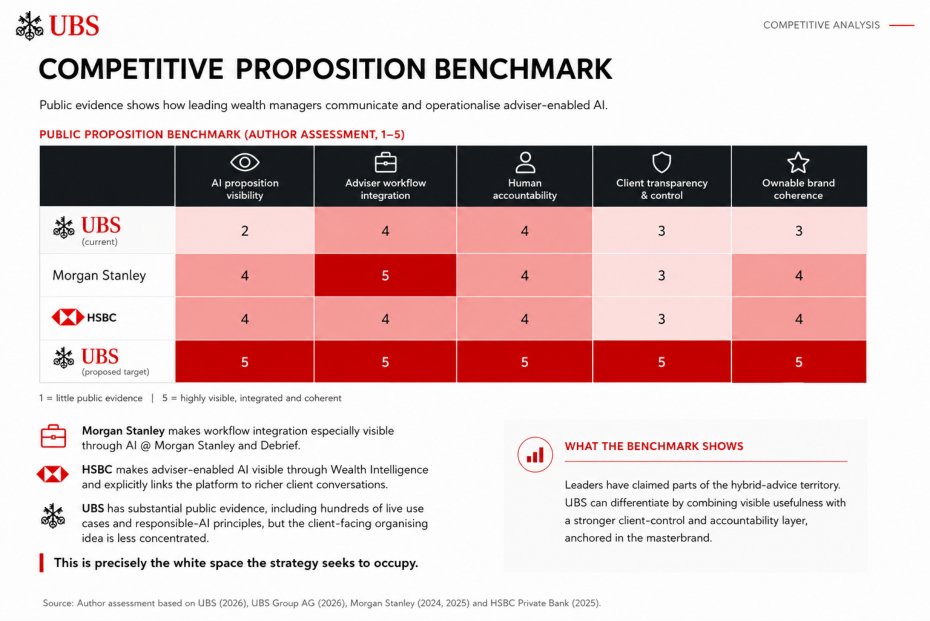
The accompanying competitive benchmark is an illustrative reading of public propositions. Its scores are the author’s judgements, not independently measured customer perceptions. The proposed UBS target represents a design ambition, not observed performance.
Morgan Stanley has given its adviser tools a visible identity through AI @ Morgan Stanley and Debrief, including consent-based meeting support and reviewed follow-up (Morgan Stanley, 2024). HSBC’s Wealth Intelligence provides another named proposition for relationship managers (HSBC Private Bank, 2025). These examples show how technology can become easier to recognise through a coherent name and use case.
Aaker’s relevance argument asks whether a brand can define a reason to choose it that changes the comparison (Aaker, 2012). For UBS, the proposed space combines useful AI with explicit human accountability. The opportunity is not uncontested. UBS would need to prove the combination through the experience: more intelligence in the room, with a named adviser responsible for what leaves it.
Competitive branding strategy
Strategic direction: UBS Augmented Advice
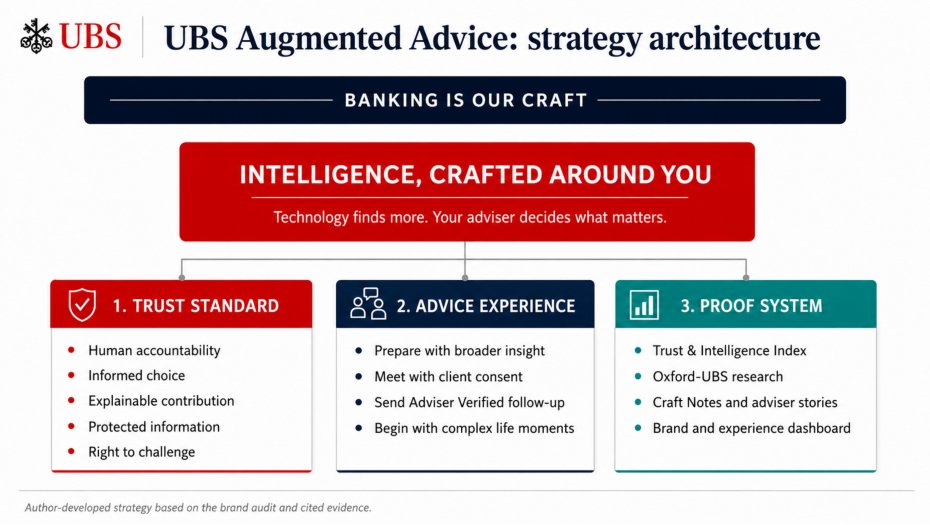
I propose UBS Augmented Advice beneath the “Banking is our craft” platform, expressed as:
Banking is our craft. Intelligence, crafted around you. Technology finds more. You and your adviser decide what matters.
The wording protects the brand’s established identity while adding a distinctive promise. “Finds more” signals scale, pattern recognition and broader research. “Decides what matters” returns agency to adviser and client. The line also avoids claims that an algorithm can understand a family, or a legacy. Huang and Rust’s (2021) framework supports this division of labour: AI is strong at automation, analysis and personalisation, while relational value still demands human interpretation. Puntoni et al. (2021) show that consumer responses to AI depend on experiences of data capture, classification and delegation. UBS should therefore brand the boundaries around AI as carefully as its benefits.
The strategy has three connected components: a standard that explains trust, an advice experience that makes augmentation useful, and evidence that makes the promise credible. The UBS masterbrand would remain in charge. Individual tools and vendors can change; the durable idea should survive today’s celebrated model becoming tomorrow’s museum piece before the campaign media plan has finished loading.
The Augmented Advice Standard
The proposed Augmented Advice Standard would apply wherever AI materially supports a client interaction or recommendation. Five commitments would anchor it:
| Proposed commitment | What it would mean |
|---|---|
| Human accountability | A named UBS professional remains responsible for client-facing advice, verification and suitability. |
| Informed choice | Clients receive clear notice when AI contributes materially and can choose appropriate levels of AI involvement where regulation and service design allow. |
| Explainable contribution | UBS explains the role AI played in plain language, including the data categories and analytical purpose. |
| Protected information | Client data stays within defined governance, security and retention boundaries, with no casual migration into public tools. |
| Right to challenge | Clients can question an output, request human review and correct information that shaped the recommendation. |
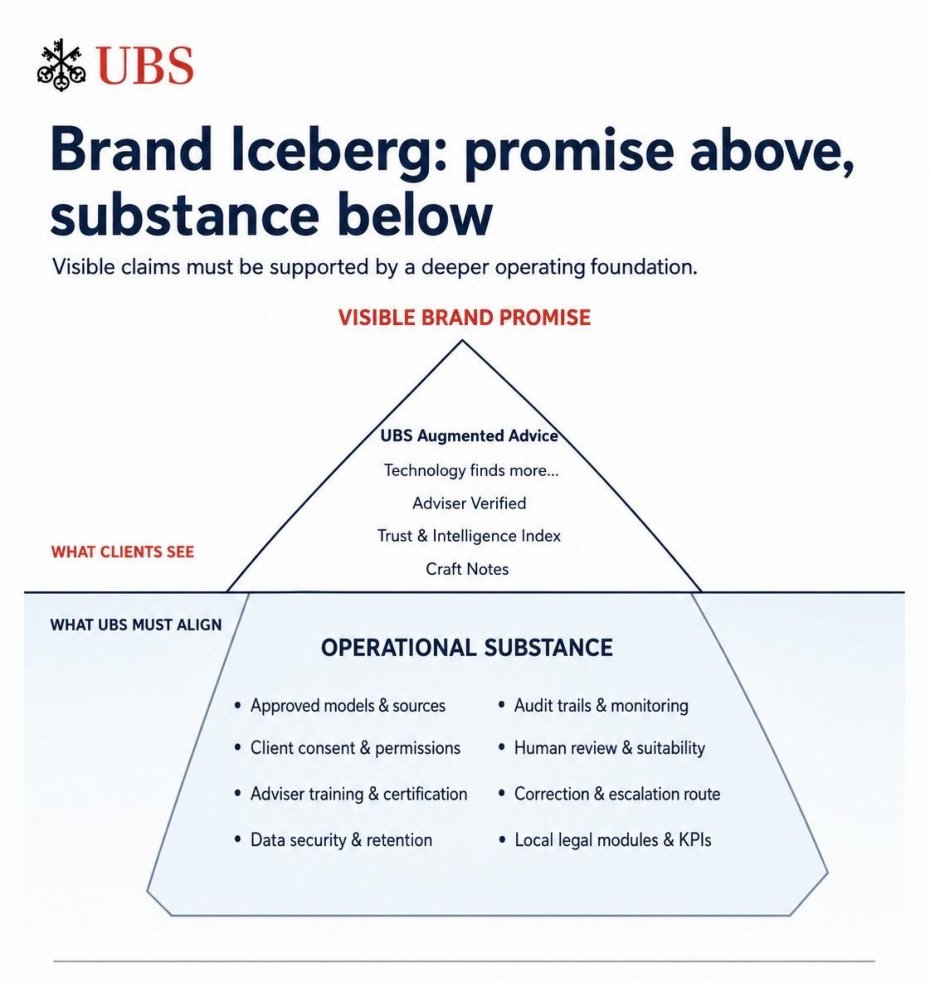
The standard would translate governance into client language. It also needs substance beneath the visible promise: trained staff, approved systems, audit trails, escalation and measurement. Davidson’s Brand Iceberg is a useful reminder that communication rests on a deeper operating foundation (Davidson, 1997).
Make augmentation visible across the journey
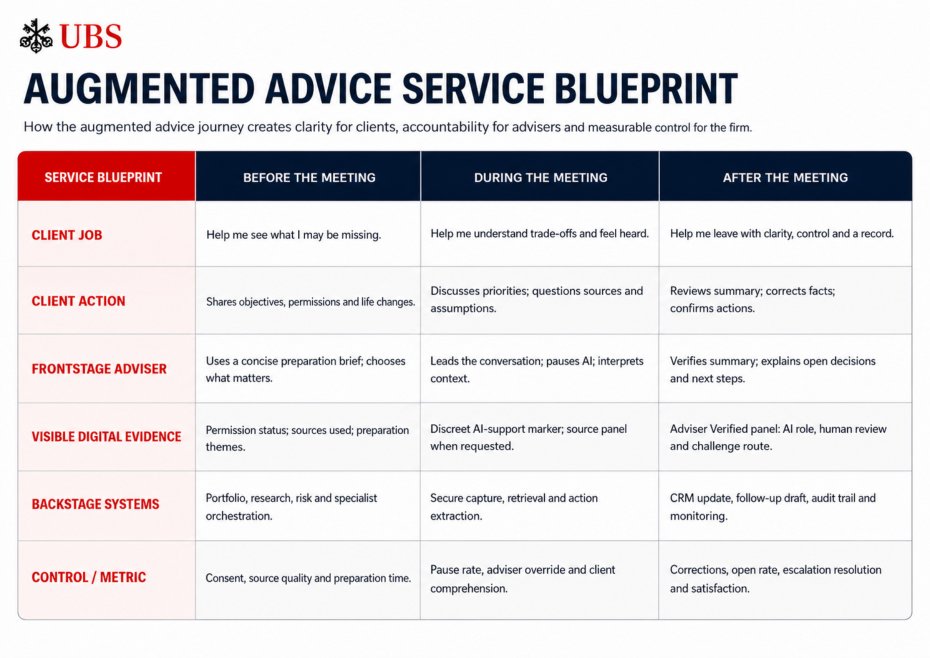
Second, UBS should redesign the advice journey around three moments.
Before the meeting, an adviser workspace could combine permitted portfolio information, relevant life events, risk signals, research and specialist insight into a preparation brief. It should surface questions and anomalies rather than settle on an answer before the client has spoken.
During the meeting, client-approved AI could capture decisions, open questions and agreed actions. The adviser would remain visibly in control and able to pause the tool. Good wealth advice often depends on the sentence after a client says, “There is one other thing.” The design must leave room for that.
After the meeting, a proposed Adviser Verified summary could explain what AI supported, what the adviser reviewed, which decisions remain open and how the client can challenge or amend the record. Morgan Stanley’s Debrief offers a relevant operational comparison (Morgan Stanley, 2024). The proposed UBS distinction is a recurring, visible client-control layer.
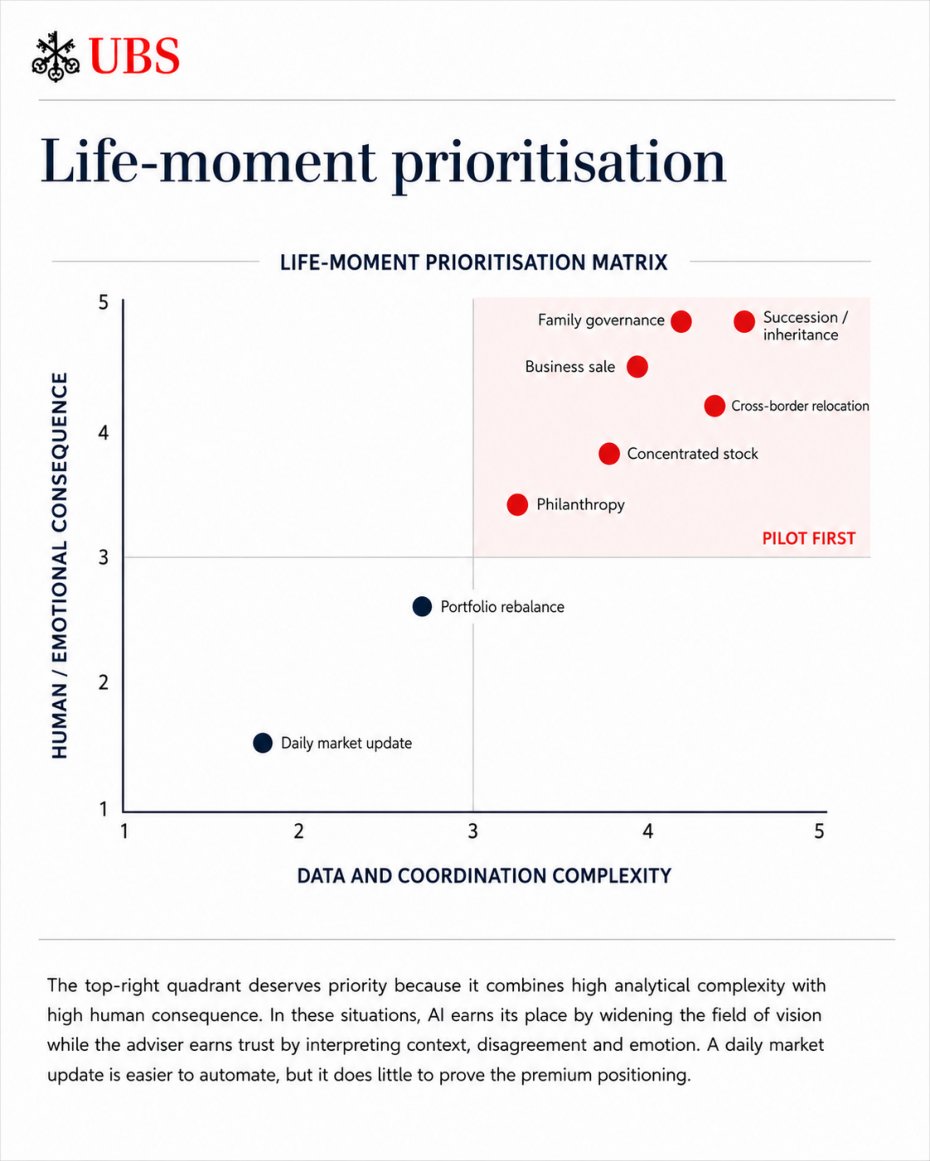
A pilot could begin with complex life events: succession planning, concentrated-stock risk, relocation, philanthropy, a business sale or family governance. These combine analytical work with emotional consequences. The accompanying prioritisation matrix is a selection aid based on strategic judgement; its positions and bubble sizes are not market-size estimates.
| Journey stage | Proposed experience |
|---|---|
| BEFORE | Adviser cockpit: Broader data, life events, risk signals and specialist insight. |
| DURING | Client-approved support: Capture decisions and actions while the adviser remains in control. |
| AFTER | Adviser Verified: Show AI contribution, adviser review, open decisions and challenge route. |
Build public proof and measure it
A proposed annual Trust and Intelligence Index could explore expectations of AI, privacy, advice and accountability across markets. Collaboration with relevant research partners would need to be agreed. The purpose would be to build evidence and useful conversations rather than simply give a campaign another name.
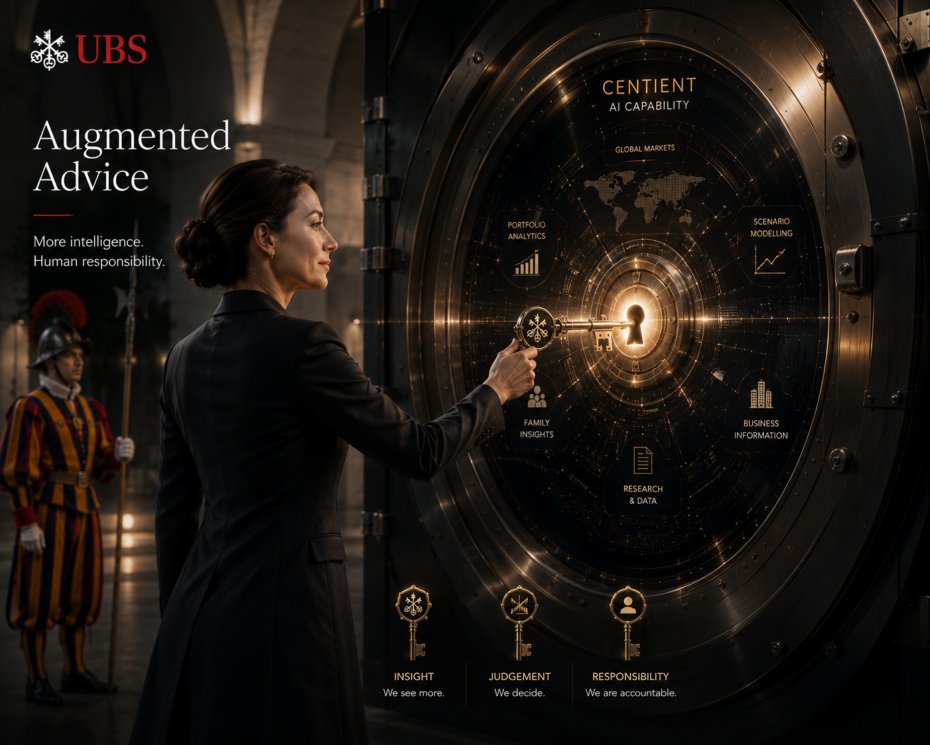
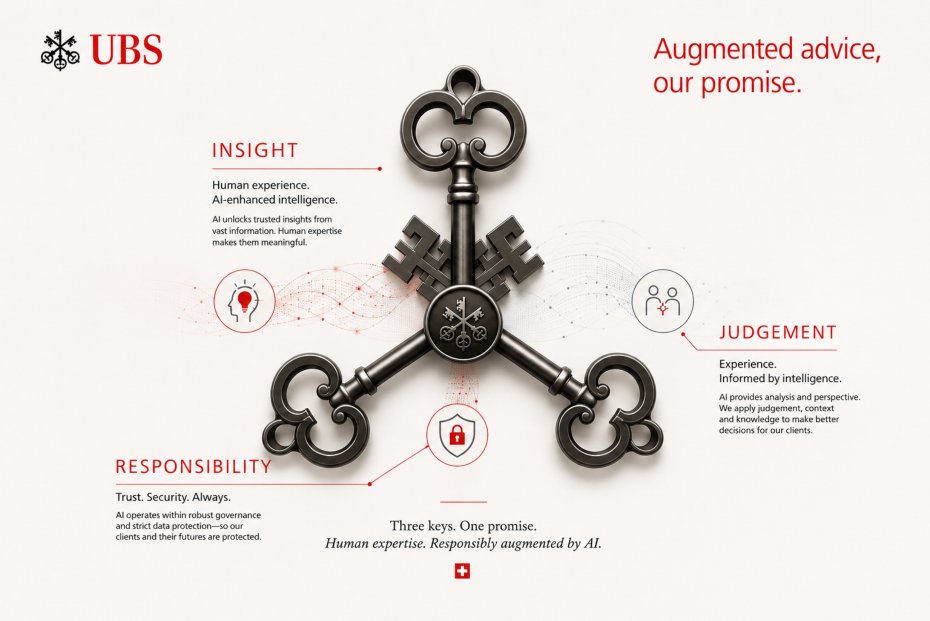
Future adviser stories could demonstrate what the technology noticed, what the adviser added and what changed, where there is evidence and permission to tell the story. Short “Craft Notes” could explain one use case at a time. The creative should feel more workshop than laboratory. As a visual concept, the three keys could organise the idea around insight, judgement and responsibility.
Existing clients could encounter the proposal through advisers and digital services; prospects through entrepreneur events, family-office forums, thought leadership and sponsorship. Next-generation family members are one audience worth testing, without assuming they share identical attitudes to AI. Before launch, advisers would need practice explaining the standard in ordinary language, including difficult questions about bias, privacy and error. Consistency should still sound personal.
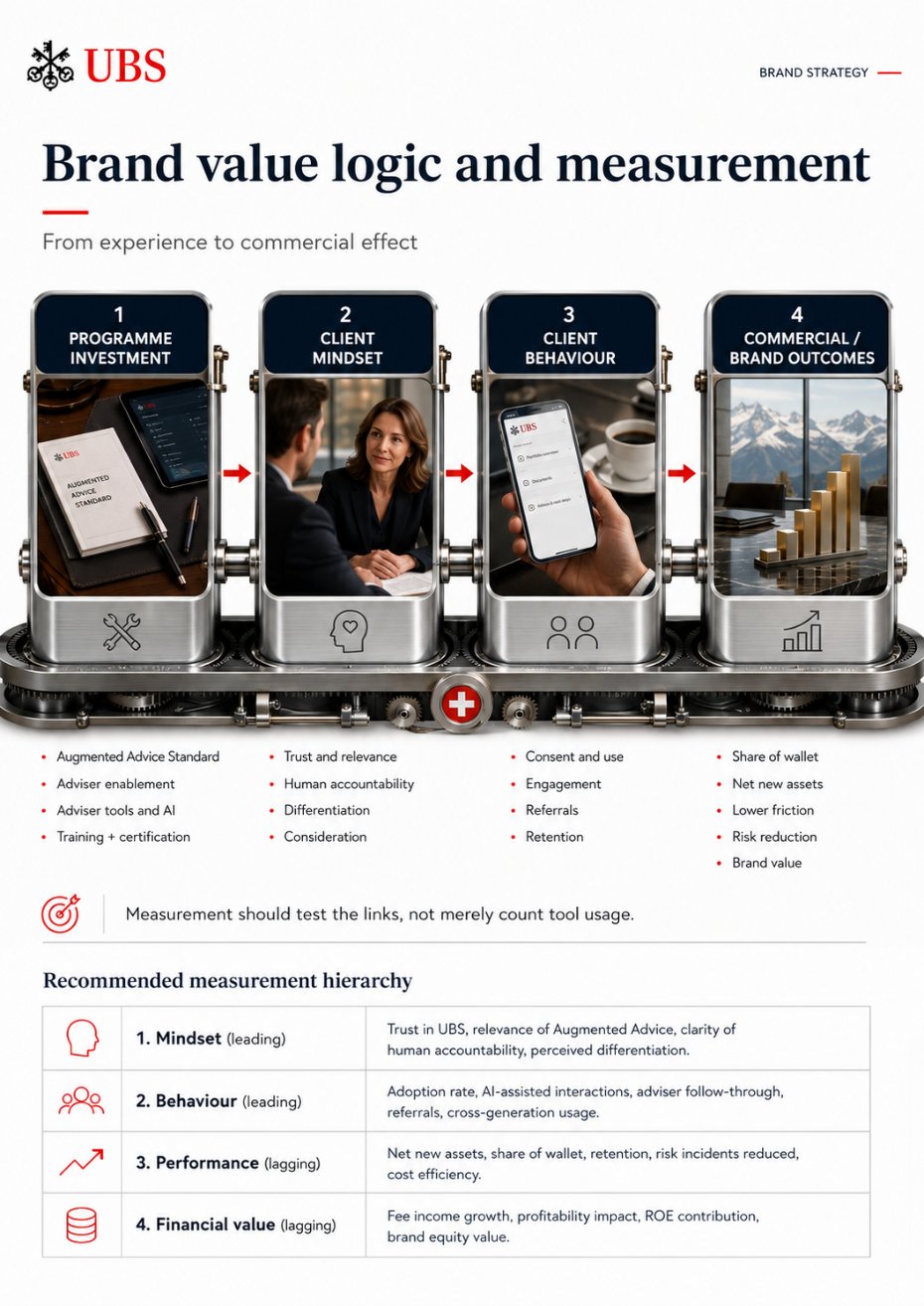
Measurement should cover both brand and behaviour. Quarterly research could test associations with responsible AI-enabled advice, personalisation, trust and consideration. Experience measures could include preparation time, adoption, consent, summary use, corrections and escalation resolution. A phased pilot across selected markets would test cultural, operational and regulatory differences. Commercial measures need appropriate comparisons because retention and asset flows have many causes.
| Measurement layer | Indicative metrics |
|---|---|
| Brand | Association with responsible AI advice; differentiation; consideration; trust. |
| Experience | Client consent; Adviser Verified open rate; corrections; escalation resolution. |
| Adviser | Adoption; preparation time; training certification; quality of client explanation. |
| Commercial | Retention; share of wallet; referrals; uptake in complex-life-moment services. |
What would make the strategy defensible?
| Resource / capability | V | R | I | O | Strategic implication |
|---|---|---|---|---|---|
| Global adviser network | ● | ◐ | ◐ | ● | Advantage improves if the experience is standardised. |
| Client and invested-asset data scale | ● | ● | ● | ◐ | Potential moat, dependent on permission, quality and orchestration. |
| Global research and specialist network | ● | ◐ | ◐ | ● | Strong support; less rare without distinctive delivery. |
| Swiss trust and craft equity | ● | ● | ● | ● | Most credible long-term brand differentiator. |
| Oxford-UBS applied-AI relationship | ● | ◐ | ◐ | ● | Proof and reputational amplifier, not a moat alone. |
| Embedded AI governance and controls | ● | ◐ | ● | ◐ | Harder to copy when built into workflow and adviser behaviour. |
This VRIO table is my qualitative interpretation of potential, not a validated company scorecard. V asks whether a resource creates value; R whether it is rare; I whether it is hard to imitate; and O whether the organisation can realise its value. A filled circle indicates a stronger case; a half circle indicates partial or execution-dependent potential.
The analysis identifies possible sources of advantage. Consistent execution, client permission, data quality and evidence of useful outcomes would determine whether that potential becomes real.
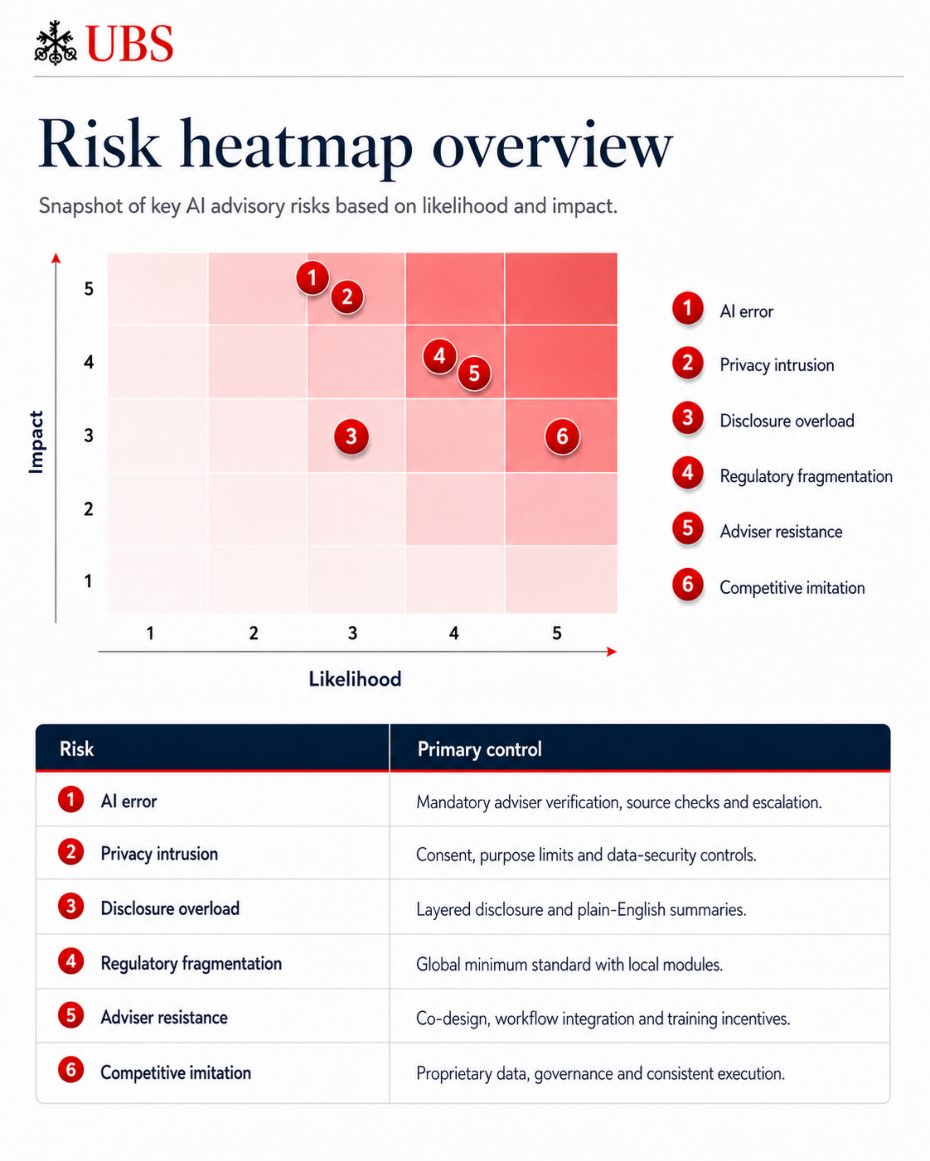
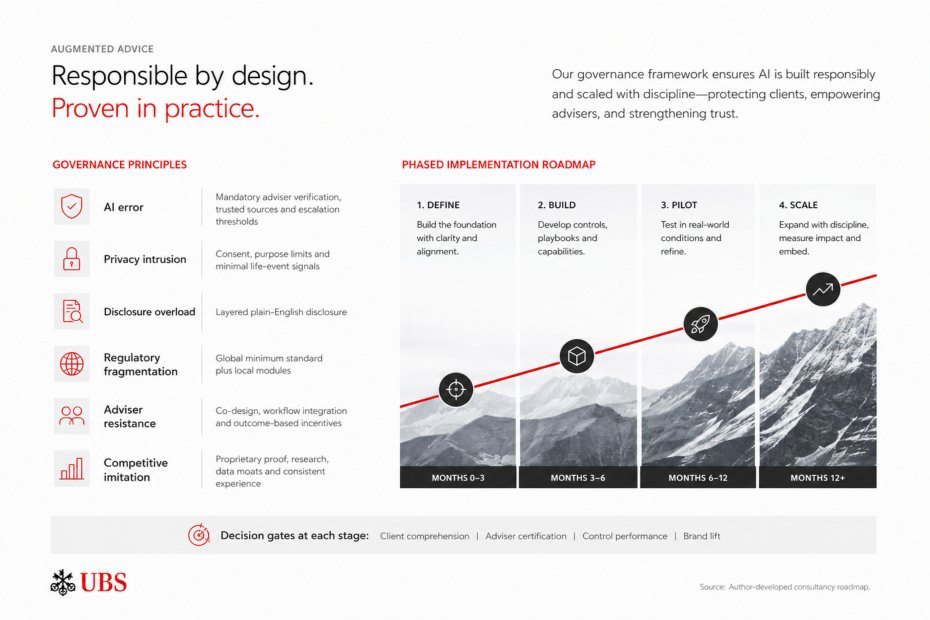
The proposal carries material risks. An AI error could damage trust; adviser verification and traceable sources reduce risk without eliminating it. Too much disclosure can overwhelm, so explanations need layers. Personalisation can feel intrusive, making consent and purpose limits essential. Different requirements across markets may also fragment the experience, which is why a common minimum standard would need appropriate local adaptation.
Adviser resistance is another risk. Co-design, workflow integration and training should reward useful client service rather than raw tool usage. Competitors can imitate campaign language quickly. The harder work is building the research access, controls, specialist coordination and consistent behaviour that make the promise believable. Any risk ratings and implementation timetable shown in the figures remain illustrative and would require validation with operational teams.
The proposal builds on existing equity rather than asking UBS to become a different kind of brand. The question is whether craft, trust and technology can become a coherent experience that clients recognise and value.
Operational foundations beneath the promise
| Foundation | Required support |
|---|---|
| Approved systems | Source controls, security, access and retention boundaries |
| Human verification | Suitability review, traceable records and escalation |
| Client understanding | Consent, understandable disclosure, correction and challenge routes |
| Organisation | Role-based training, monitoring and appropriate local requirements |
UBS has already built much of the engine. The missing asset is a visible steering wheel. UBS Augmented Advice would give clients a simple reason to value AI at the bank: broader intelligence, sharper preparation and faster follow-through, governed by a person whose name they know. That promise is current, commercially useful and difficult to own credibly without UBS’s combination of scale, Swiss discipline and adviser relationships. In an industry racing to sound intelligent, accountability may become the smartest brand move of all across markets, generations and moments of uncertainty.

References.
- Aaker, D. A. (2012). Win the brand relevance battle and then build competitor barriers. California Management Review, 54(2), 43–57. https://doi.org/10.1525/cmr.2012.54.2.43
- Barney, J. B. (1991). Firm resources and sustained competitive advantage. Journal of Management, 17(1), 99–120. https://doi.org/10.1177/014920639101700108
- Berry, L. L. (2000). Cultivating service brand equity. Journal of the Academy of Marketing Science, 28(1), 128–137. https://doi.org/10.1177/0092070300281012
- Bitner, M. J., Ostrom, A. L., & Morgan, F. N. (2008). Service blueprinting: A practical technique for service innovation. California Management Review, 50(3), 66–94. https://doi.org/10.2307/41166446
- Brand Finance. (2025, March 20). Swiss banking brands show resilient brand value growth despite recent challenges. https://brandfinance.com/press-releases/swiss-banking-brands-show-resilient-brand-value-growth-despite-recent-challenges
- Capgemini Research Institute. (2026). World Wealth Report 2026: Wealth.AI, unlocking personalization through augmented intelligence. https://www.capgemini.com/insights/research-library/world-wealth-report/
- Christensen, C. M., Hall, T., Dillon, K., & Duncan, D. S. (2016). Know your customers’ "jobs to be done." Harvard Business Review, 94(9), 54–62.
- Davidson, H. (1997). Even more offensive marketing. Penguin.
- Doctorow, C. (2026). The reverse centaur’s guide to life after AI: How to think about artificial intelligence before it’s too late. Verso.
- EY. (2025). How wealth managers can leverage complexity for competitive advantage. https://www.ey.com/en_uk/insights/wealth-asset-management/how-wealth-managers-can-leverage-complexity-for-competitive-advantage
- EY. (2026, April 24). Nearly half of global consumers now use AI to guide savings and investment decisions. https://www.ey.com/en_gl/newsroom/2026/04/nearly-half-of-global-consumers-now-use-ai-to-guide-savings-and-investment-decisions
- Green, B. (2021). The contestation of tech ethics: A sociotechnical approach to technology ethics in practice. Journal of Social Computing, 2(3), 209–225. https://doi.org/10.23919/JSC.2021.0018
- Grossman, S. J., & Stiglitz, J. E. (1980). On the impossibility of informationally efficient markets. American Economic Review, 70(3), 393–408. https://www.jstor.org/stable/1805228
- HSBC Holdings plc. (2026, June 24). The trust threshold: AI makes investors bolder, but they want human judgement to make decisions. https://www.hsbc.com/news-and-views/news/media-releases/2026/the-trust-threshold-ai-makes-investors-bolder-but-they-want-human-judgement-to-make-decisions
- HSBC Private Bank. (2025, September 16). HSBC deploys Wealth Intelligence for its wealth management staff to enhance client experience. https://www.privatebanking.hsbc.com/media-releases-and-news/hsbc-deploys-wealth-intelligence/
- Huang, M.-H., & Rust, R. T. (2021). A strategic framework for artificial intelligence in marketing. Journal of the Academy of Marketing Science, 49, 30–50. https://doi.org/10.1007/s11747-020-00749-9
- Kapferer, J.-N. (2012). The new strategic brand management: Advanced insights and strategic thinking (5th ed.). Kogan Page.
- Keller, K. L. (1993). Conceptualizing, measuring, and managing customer-based brand equity. Journal of Marketing, 57(1), 1–22. https://doi.org/10.1177/002224299305700101
- Keller, K. L. (1999). Managing brands for the long run: Brand reinforcement and revitalization strategies. California Management Review, 41(3), 102–124.
- Keller, K. L., & Lehmann, D. R. (2003). How do brands create value? Marketing Management, 12(3), 26–31.
- Lemon, K. N., & Verhoef, P. C. (2016). Understanding customer experience throughout the customer journey. Journal of Marketing, 80(6), 69–96. https://doi.org/10.1509/jm.15.0420
- Mercedes-AMG PETRONAS Formula One Team. (n.d.). UBS. https://www.mercedesamgf1.com/partners/ubs
- Morgan Stanley. (2024, June 26). Morgan Stanley Wealth Management announces latest game-changing addition to suite of GenAI tools. https://www.morganstanley.com/press-releases/ai-at-morgan-stanley-debrief-launch
- Morgan Stanley. (2025, June 30). Morgan Stanley wins 2025 Celent Model Wealth Manager awards. https://www.morganstanley.com/press-releases/morgan-stanley-wins-2025-celent-model-wealth-manager-awards
- Puntoni, S., Reczek, R. W., Giesler, M., & Botti, S. (2021). Consumers and artificial intelligence: An experiential perspective. Journal of Marketing, 85(1), 131–151. https://doi.org/10.1177/0022242920953847
- Raji, I. D., Smart, A., White, R. N., Mitchell, M., Gebru, T., Hutchinson, B., Smith-Loud, J., Theron, D., & Barnes, P. (2020). Closing the AI accountability gap: Defining an end-to-end framework for internal algorithmic auditing. In Proceedings of the 2020 Conference on Fairness, Accountability, and Transparency (pp. 33–44). Association for Computing Machinery. https://doi.org/10.1145/3351095.3372873
- Shneiderman, B. (2020). Bridging the gap between ethics and practice: Guidelines for reliable, safe, and trustworthy human-centered AI systems. ACM Transactions on Interactive Intelligent Systems, 10(4), Article 26. https://doi.org/10.1145/3419764
- Shneiderman, B. (2020). Human-centered artificial intelligence: Reliable, safe & trustworthy. International Journal of Human-Computer Interaction, 36(6), 495–504. https://doi.org/10.1080/10447318.2020.1741118
- UBS. (2024, January 23). UBS launches new global brand campaign "Banking is our craft". https://www.ubs.com/global/en/media/display-page-ndp/en-20240123-craft.html
- UBS. (2024, September 21). UBS renews its partnership with the Mercedes-AMG PETRONAS Formula One Team. https://www.ubs.com/global/en/media/display-page-ndp/en-20240921-f1.html
- UBS. (2026). Innovation and AI at UBS. https://www.ubs.com/global/en/our-firm/what-we-do/technology/innovation-and-ai.html
- UBS Group AG. (2026). Annual report 2025. https://www.ubs.com/content/dam/assets/cc/investor-relations/annual-report/2025/annual-report-ubs-group-2025.pdf