
An organisation can publish thoughtful AI principles and still face a difficult question: do the measures used to reward success reinforce those principles? In digital businesses, responsibility is expressed through product design, commercial incentives and board oversight as well as through public commitments.
Alphabet provides a useful lens because advertising is a major part of its business and its products help organise attention and information at enormous scale. The strategic issue is the relationship between a commercial model that benefits from useful, repeated engagement and a social commitment to users' wellbeing.
This is an analysis of that structural tension, written in February 2026. It does not establish the confidential objective functions of Google's systems, the contents of internal dashboards or the performance measures used to assess particular employees. Those are precisely the matters a serious governance review would need to investigate rather than assume.
My central question is this: how can an AI business demonstrate that responsible design shapes the definition of success, instead of appearing only in the language surrounding it?
Social sustainability reaches into product design
Social sustainability includes the conditions that allow people to participate safely and meaningfully in society. Digital access, mental wellbeing, privacy and the quality of information environments belong in that discussion. They cannot be separated entirely from the design of services through which people spend time, seek reassurance and encounter other people.
The United Nations' Sustainable Development Goal 3 places health and wellbeing within a broad sustainability framework. For a digital company, this does not mean that every minute of screen time is a harm or that every product must become a health intervention. It means that the possible effects of design deserve a place in decisions about how growth is pursued.
The U.S. Surgeon General's 2023 advisory identifies both potential benefits and risks of social media for young people and substantial gaps in what is known. The distinction between association and causation matters. People experiencing distress may use digital services differently; particular forms of use may also intensify distress. A broad association cannot establish that a specific company's algorithm caused an individual outcome.
That uncertainty should make measurement more careful. It should not make the governance question disappear. Boards routinely make decisions under incomplete evidence. The useful task is to identify plausible pathways of harm, examine the populations and contexts affected, and test proportionate design responses while also measuring the benefits people receive.
Attention is economically valuable, but time is an incomplete measure
The attention-economy perspective helps explain the commercial tension. Attention is scarce. Advertising-supported services can create value by connecting audiences, useful content and relevant commercial messages. Repeated use can signal that a product is valuable and can support a viable business (Davenport and Beck, 2001; Srnicek, 2017).
But time spent is not identical to value received. A long session might mean a person is learning a language, enjoying a film or speaking to friends. It might also mean that the person has struggled to stop, has followed a recommendation sequence they regret or cannot quickly find an answer. A short session could indicate dissatisfaction, or it could indicate a task completed exceptionally well.
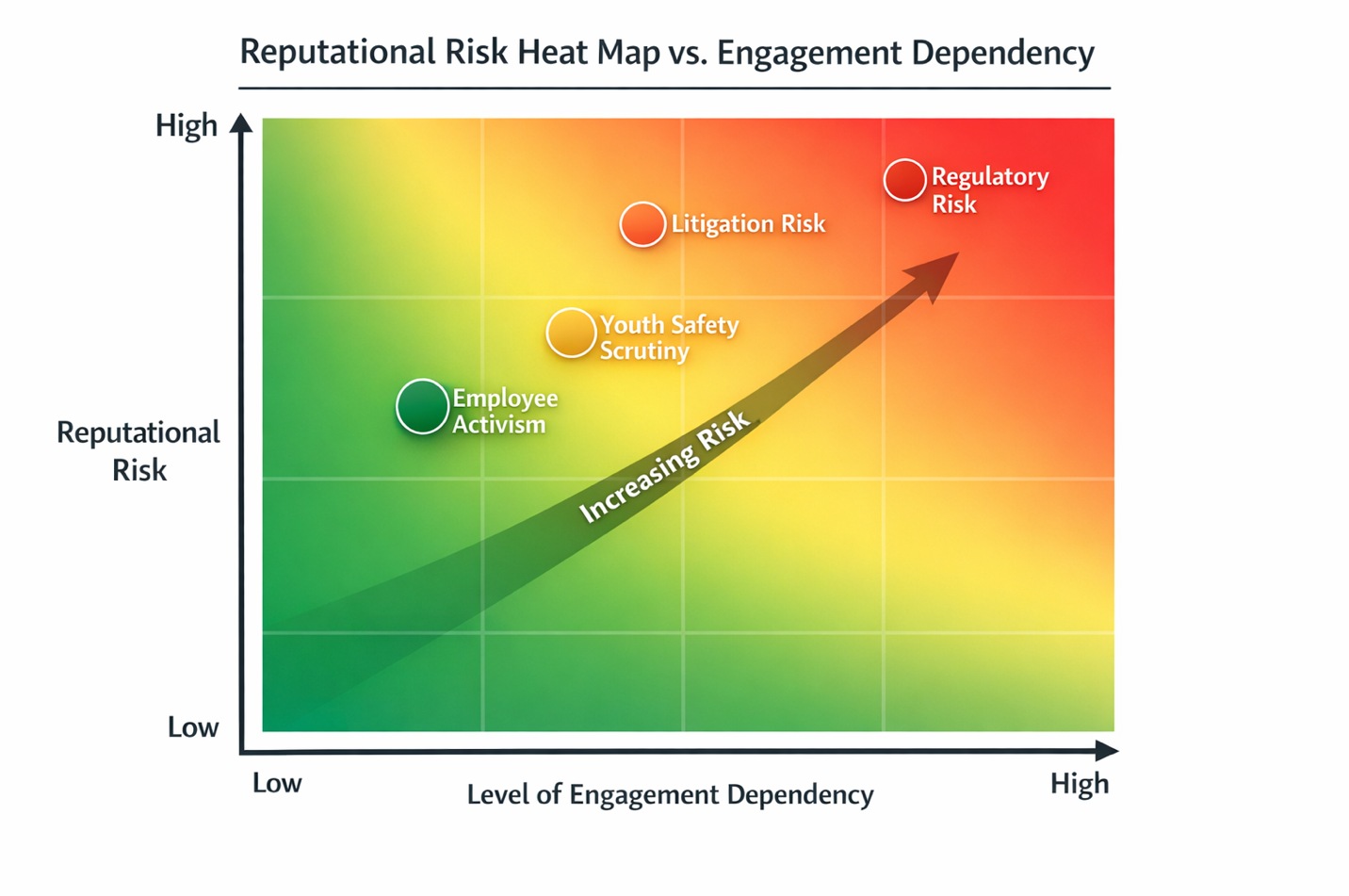
The commercial danger is to let an easily observed proxy become the whole definition of success. Where longer sessions or deeper interaction are rewarded without adequate context, teams have an incentive to improve those measures. The question is then whether the measures continue to represent the outcome the company says it wants to create.
Fogg's Behaviour Model offers one way to examine the design mechanisms. Behaviour depends on motivation, ability and prompts. Interfaces can reduce effort, make a response more appealing and supply timely prompts. None of that is inherently harmful: the same principles can help a person remember an appointment or complete an important task. Their significance depends on the outcome being encouraged and the user's ability to retain meaningful control (Fogg, 2009).
Autoplay, recommendations and notifications should therefore be examined as design choices with trade-offs. They can make a service convenient. They can also reduce natural stopping points or encourage repeated checking. A governance process needs to ask when these features help the user and when their design primarily helps a commercial proxy.
Principles, controls and incentives do different jobs
Google's public AI principles and responsible AI reporting provide a starting point for considering how responsibility is organised. Published commitments, testing processes and review mechanisms matter. They tell stakeholders what the organisation intends to do and can provide a basis for accountability.
However, three layers should be distinguished. Principles establish the purpose and boundaries. Controls identify and manage particular risks. Incentives shape what teams pursue every day. A company can make progress on all three, but evidence of one is not complete evidence of the others.
For example, a review process might assess whether a system produces a prohibited output. A different question is whether the product's success measures reward a pattern of use that users later regret. Both deserve attention, but they require different evidence. The first concerns a defined failure; the second concerns the objective around which the product evolves.
| Governance layer | Central question | Useful evidence |
|---|---|---|
| Public principles | What outcomes does the organisation commit to supporting or avoiding? | Clear commitments, boundaries and published responsibilities |
| Product controls | How are foreseeable risks identified, tested and addressed? | Evaluation methods, incident response, escalation and mitigation records |
| Performance incentives | What does the organisation reward as success? | Metric definitions, trade-off decisions and evidence that quality can outweigh raw engagement |
| Board oversight | Who reviews the balance between commercial performance and user outcomes? | Accountable owners, reporting cadence and documented decisions |
A board should be able to follow that chain from a public promise to an operational decision. If a wellbeing concern conflicts with a growth metric, what happens? Who decides, what evidence is required, and can a team succeed commercially while choosing a healthier design? Those questions are more revealing than the number of times a company uses the word “responsible.”
A stakeholder problem, not simply a communications problem
Stakeholder theory broadens the analysis beyond immediate shareholder returns. Users, advertisers, employees, regulators and investors can all benefit from a useful digital service, but they experience different risks and time horizons (Freeman et al., 2010).
Advertisers may value relevant reach and measurable responses. Users may value convenience, entertainment, discovery and control. Investors want durable returns, while also bearing the consequences of litigation, lost trust or abrupt policy changes. Employees may care about both product achievement and whether the work is consistent with their professional values.
| Stakeholder | Value sought | Potential concern | Implication for governance |
|---|---|---|---|
| Users, including younger users | Useful information, connection, enjoyment and agency | Unwanted intensity, poor information or reduced control | Examine benefits and risks by context and audience |
| Advertisers | Relevant audiences and effective communication | Poor-quality attention or deteriorating trust | Evaluate attention quality as well as quantity |
| Investors | Revenue, resilience and long-term value | Regulatory exposure, reputation and unstable growth assumptions | Make material trade-offs visible |
| Regulators and civil society | Fair treatment, accountability and public wellbeing | Risks that individual users cannot readily assess | Provide meaningful evidence and accessible scrutiny |
| Employees | Product progress and professional integrity | Conflicting incentives or unclear escalation | Align responsibilities with the ability to act |
This is also a legitimacy question. People judge organisations against changing expectations. A design once celebrated purely as frictionless innovation may later be questioned because of the behaviour it encourages. A company cannot control every change in public opinion, but it can ensure that its explanation of responsibility is supported by observable decisions.
Digital wellbeing tools can contribute to that explanation. Timers, focus modes and usage information give users options. Their existence does not settle the larger question of how defaults and recommendations shape behaviour. A tool that asks the user to manage their own attention and a product architecture that supports that effort should be assessed together.
Three strategic routes
The first option is to preserve the existing commercial emphasis while increasing transparency and communicating governance more clearly. This can improve understanding where meaningful controls already exist. Its limitation is that better explanation cannot resolve a substantive conflict between a promise and the way a product is rewarded.
The second option is to expand wellbeing features while leaving the central success measures largely intact. More understandable controls, useful stopping cues and appropriate protections for younger users could produce real benefits. The risk is that they remain peripheral to decisions about the core product, particularly if the organisation continues to reward outcomes that work against them.
The third option is to incorporate measures of user value, control and potentially harmful intensity into product evaluation and governance. This does not require treating all engagement as undesirable. It means distinguishing valuable engagement from engagement that the user did not intend or does not value, and giving that distinction weight in decisions.
| Strategic option | Main advantage | Main limitation |
|---|---|---|
| Explain existing governance more clearly | Builds understanding and may preserve continuity | Communication alone cannot repair a substantive incentive conflict |
| Add wellbeing features | Provides visible, potentially useful interventions | Features can remain secondary to the measures governing the core product |
| Integrate user outcomes into performance and oversight | Connects responsibility to the definition of success | Requires difficult measurement, trade-offs and organisational change |
I favour the third route, with useful elements of the second. It addresses the source of the tension rather than relying entirely on the user to manage it. The case is strategic as well as ethical: a business that understands the quality of the attention it earns is better placed to defend its value proposition and adapt to scrutiny.
What implementation could look like
The first phase would be a metric audit. Leadership should establish which measures matter most in each product, what those measures are intended to represent and where they may be misleading. Search, video recommendations and a generative assistant should not be treated as interchangeable experiences. A successful answer may reduce time spent; an enjoyable video may appropriately extend it.
The audit should pair quantitative signals with user research. Repeated late-night use, for example, cannot diagnose poor wellbeing on its own. Someone may work a night shift, live in another time zone or be enjoying an intentional activity. Any proxy needs context, privacy protection and a clear explanation of what can and cannot be inferred.
The second phase would test alternatives in controlled settings. Examples include clearer stopping cues, easier control of recommendations, more understandable notification settings and explicit measures of task completion or user satisfaction. Evaluation should examine whether the changes improve agency and value while checking for exclusion, accessibility problems and unintended effects.
The third phase would align oversight. Board reporting should include the material trade-offs identified by the tests, not just a positive headline. Teams need clear responsibility for action, and any changes to incentives should follow evidence about the measures rather than reward an attractive but weak wellbeing score.
The final phase would strengthen external accountability. Useful reporting would explain the problem addressed, the intervention, the evaluation method and the limits of the findings. Independent scrutiny can help where it is feasible and appropriate. A claim that something improved needs a defined outcome and a basis for comparison.
Measurement can create a second problem
Wellbeing is not a simple number. Once an organisation rewards a proxy, people may optimise for that proxy instead of the underlying outcome. A system that reduces measured session duration could make a task harder. A satisfaction score could miss users who disengage altogether. An intervention could help an average user while creating problems for a smaller group.
There are commercial trade-offs too. Some changes may affect advertising inventory, usage patterns or competitive position. These effects should be modelled and examined rather than denied. Responsible governance does not promise that every decision will improve every outcome at once; it makes the choices and their consequences visible.
Alternative AI approaches also offer ideas without proving a complete solution. Constitutional AI, for example, illustrates how explicit normative principles can enter a model-development process (Bai et al., 2022). It does not establish that a company using that method has solved digital wellbeing, or that a subscription business is automatically free of engagement incentives. The relevant lesson is that objectives can be designed and evaluated rather than treated as inevitable.
The decisive question is whether the organisation can show how its commitments change a decision. A responsible AI brand becomes more credible when a product team can explain why a design was changed, what user outcome improved and how leadership handled the commercial trade-off. Wellbeing then becomes part of how the business governs itself, with marketing communicating evidence that already exists.


References.
- Alphabet Inc. (2023). Form 10-K annual report 2023. https://abc.xyz/investor/
- Google. (2023). Responsible AI progress report. Google AI.
- Google. (2024). AI principles. https://ai.google/principles/
- United Nations. (2015). Transforming our world: The 2030 Agenda for Sustainable Development. https://sdgs.un.org/2030agenda
- U.S. Surgeon General. (2023). Social Media and Youth Mental Health: The U.S. Surgeon General’s Advisory. U.S. Department of Health and Human Services.
- Davenport, T. H., & Beck, J. C. (2001). The Attention Economy: Understanding the New Currency of Business. Harvard Business School Press.
- Srnicek, N. (2017). Platform Capitalism. Polity.
- Fogg, B. J. (2009). A behavior model for persuasive design. Proceedings of the 4th International Conference on Persuasive Technology. https://doi.org/10.1145/1541948.1541999
- Freeman, R. E., Harrison, J. S., Wicks, A. C., Parmar, B. L., & De Colle, S. (2010). Stakeholder Theory: The State of the Art. Cambridge University Press.
- Bai, Y., et al. (2022). Constitutional AI: Harmlessness from AI feedback. https://arxiv.org/abs/2212.08073
- Vredenburg, J., Kapitan, S., Spry, A., & Kemper, J. A. (2020). Brands taking a stand: Authentic brand activism or woke washing? Journal of Public Policy & Marketing, 39(4), 444–460. https://doi.org/10.1177/0743915620947359
- Zuboff, S. (2019). The Age of Surveillance Capitalism. Profile Books.